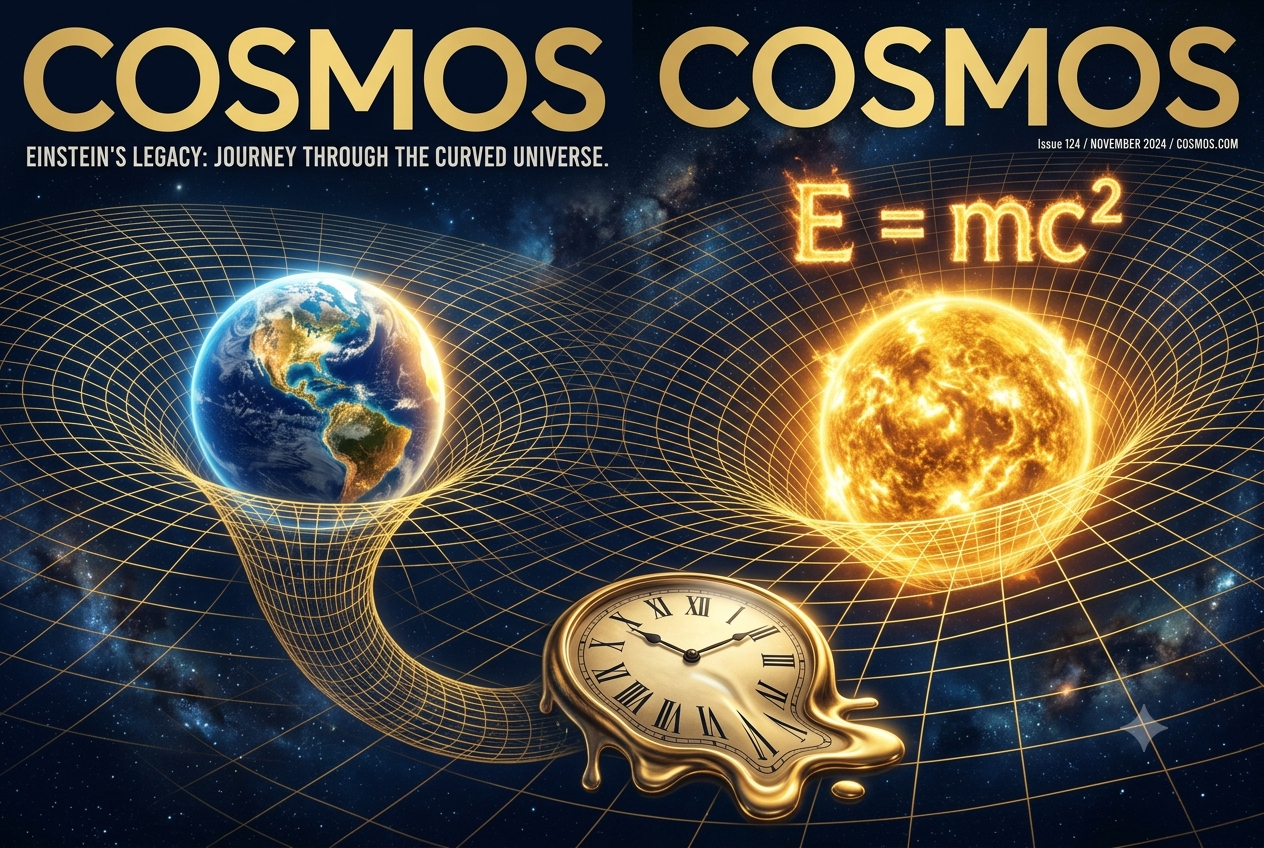
Black holes exist because of Einstein.
The atom bomb, nuclear energy, and our understanding of stars — all rooted in one equation Einstein wrote in 1905: E = mc².
But what does the Theory of Relativity actually say? Why does time slow down when you move fast? Why does mass bend space? And what on Earth does any of this have to do with your daily life?
Let’s find out — in plain language, with no maths degree required.
Albert Einstein published two theories that changed our picture of the universe forever. The first, in 1905, was Special Relativity. The second, in 1915, was General Relativity. Together, they replaced Newton’s picture of space and time with something far stranger — and far more accurate.
By the end of this post, you will understand both. Let’s start at the beginning. 🚀
🚂 Part 1: Special Relativity — What Happens When You Move Very Fast
The big question Einstein asked himself
In 1895, a 16-year-old Albert Einstein asked himself a strange question: “What would I see if I rode alongside a beam of light at the same speed?”
According to classical physics, if you ran alongside a train at the same speed, the train would look still. So if you chased a light beam at the speed of light, the light should look frozen — like a still wave hanging in space.
But Einstein realised this was impossible. Light cannot stand still. Every experiment ever done shows that light always travels at the same speed — 299,792 kilometres per second — no matter how fast the observer is moving. This became the foundation of Special Relativity.
The two rules everything else comes from
Einstein built all of Special Relativity on just two simple ideas:
- Rule 1 — The laws of physics are the same for everyone who is moving at a constant speed. Whether you are sitting still or zooming through space at a million km/h — the same physics applies.
- Rule 2 — The speed of light is always the same — exactly 299,792 km/s — no matter who measures it or how fast they are moving.
These two rules sound simple. But their consequences shake the foundations of everything we thought we knew about time and space.
⏱ 2. Time Dilation — Time Actually Slows Down When You Move Fast
This is the most mind-bending consequence of Special Relativity, and it is completely real and experimentally proven.
If you move very fast, time passes more slowly for you than for someone standing still. This is not just an illusion or a measurement trick. Time itself genuinely slows down for the faster-moving person. Einstein called this time dilation.
The light clock thought experiment
Imagine a clock that works by bouncing a beam of light between two mirrors. Every time the light bounces, the clock “ticks.”
Now imagine this clock is on a spaceship moving very fast. You are watching from Earth. From your point of view, the light beam no longer travels straight up and down — it travels at a diagonal, covering a longer distance with each tick. But the speed of light cannot change (Rule 2). So if the light travels a longer distance at the same speed, each tick must take more time. The moving clock runs slow.
The Twin Paradox — the most famous example
Imagine twins — let’s call them Anika and Ben. Anika boards a spaceship and flies away at 90% the speed of light for 5 years, then returns. Ben stays on Earth.
When Anika lands, Ben has aged about 23 years. Anika has only aged 5 years. They are the same age when they leave — but when Anika returns, she is 18 years younger than her twin brother. Time literally passed more slowly for the faster-moving twin. This is not science fiction. The maths is completely solid.
💥 3. E = mc² — The Most Famous Equation in History
Special Relativity also gave us the most famous equation ever written: E = mc².
What does it mean in plain English?
- E = Energy
- m = mass (how much matter something has)
- c = the speed of light (299,792 km/s)
- c² = the speed of light multiplied by itself — an enormous number
The equation says: mass and energy are the same thing, just in different forms. A tiny amount of mass contains an enormous amount of energy — because you multiply by c², which is about 90 billion kilometres² per second².
🌍 4. General Relativity — Gravity Is Not a Force. It Is Curved Space.
In 1915, Einstein went further. He asked: what about gravity? His Special Relativity only dealt with objects moving at constant speeds. What about acceleration? What about falling objects? What about planets orbiting stars?
His answer stunned the world. Gravity is not a force pulling objects together. Gravity is the curvature of space and time caused by mass.
The rubber sheet analogy
Imagine space as a flat rubber sheet stretched tight. Now place a heavy ball (the Sun) on the sheet. The sheet curves and sags around the ball. If you roll a marble nearby, it curves inward — not because the ball is “pulling” the marble, but because the marble is following the curved surface of the sheet.
This is what happens in space. The Earth orbits the Sun not because the Sun is pulling it with an invisible rope, but because the Sun’s mass curves the fabric of space and time, and the Earth follows that curve.
📡 5. Real-World Proof — Relativity Is All Around You
Relativity is not just a beautiful theory. It has been tested hundreds of times and is used in everyday technology right now.
Your GPS uses both types of relativity
GPS satellites orbit Earth at about 14,000 km/h. Because of Special Relativity (moving fast → time slows), their clocks run slightly slow compared to clocks on Earth — by about 7 microseconds per day. Because of General Relativity (farther from Earth’s gravity → time runs faster), their clocks run slightly fast — by about 45 microseconds per day. The net result is a 38 microsecond drift every day. If this was not corrected, GPS would be off by about 10 kilometres every day. Your phone’s GPS app works because Einstein’s corrections are built into every satellite.
Other real-world proofs
- 🌑 Black holes — predicted by General Relativity, confirmed by direct imaging in 2019 (the famous photo of M87’s black hole and Sagittarius A* in 2022).
- 🌊 Gravitational waves — Einstein predicted in 1916 that massive objects create ripples in spacetime. Detected for the first time in 2015 by LIGO — a century after the prediction.
- ⭐ Bending of starlight — General Relativity predicts that massive objects bend light. Proven in 1919 during a solar eclipse, making Einstein world-famous overnight.
- ☢️ Nuclear power — Every nuclear power plant and every nuclear weapon works because of E = mc². Mass is converted to energy exactly as Einstein said.
- 🔴 Gravitational redshift — Light climbing out of a gravitational field loses energy and shifts toward the red end of the spectrum. Measured precisely on Earth and in space.
🚀 The Future: What Relativity Still Has to Teach Us
Over 100 years later, Einstein’s theories are still guiding our biggest scientific adventures:
- 🌊 Gravitational wave astronomy — LIGO and future detectors like LISA (a space-based detector) will map black hole mergers, neutron star collisions, and possibly the echo of the Big Bang — all through ripples in spacetime.
- 🕳️ Black hole physics — The boundary between General Relativity and quantum mechanics breaks down at black hole singularities. Solving this clash is the biggest open problem in all of physics.
- 🚀 Interstellar travel — If humans ever travel at significant fractions of the speed of light, time dilation becomes practically important. Astronauts travelling to nearby stars would return younger than the people they left behind.
- ⚛️ Quantum gravity — General Relativity and quantum mechanics each work perfectly in their own domain. Unifying them into one theory of “quantum gravity” is the holy grail of modern physics — and relativity is at the heart of the puzzle.
- 🌌 Dark energy and the expanding universe — Einstein’s equations contain a term called the “cosmological constant” that may explain why the universe’s expansion is accelerating. The final understanding of our universe’s fate runs through General Relativity.
Einstein gave us the map. We are still exploring the territory it describes.
⚡ Key Takeaways — Share These!
- ⚡ Special Relativity says the speed of light is always the same for everyone — and this forces time and space to behave in strange ways.
- ⏱ Time dilation is real and proven: moving clocks run slower. Flying atomic clocks, GPS satellites, and particle accelerators all confirm this.
- 💥 E = mc² means mass and energy are the same thing. A tiny amount of mass contains a city-powering amount of energy. The Sun, nuclear plants, and particle physics all run on this.
- 🌍 General Relativity says gravity is not a force — it is the curvature of spacetime caused by mass. Earth orbits the Sun by following that curve.
- 📡 Your GPS works because of Einstein — relativity corrections are built into every satellite to stop your navigation drifting by 10 km per day.
- 🌊 Black holes and gravitational waves — both predicted by General Relativity and both confirmed by direct observation. Einstein was right about everything.
🌟 Final Thoughts: The Universe Einstein Gave Us
Before Einstein, the universe seemed predictable and mechanical — a giant clockwork governed by Newton’s fixed, absolute rules. Time was time. Space was space. They were separate, rigid, and the same for everyone.
Einstein tore that picture apart and replaced it with something far stranger and far more beautiful. Space and time are woven together into a single fabric — spacetime — that bends, stretches, and curves in response to mass and energy. Time is not fixed. It flows at different rates depending on how fast you move and where you are in a gravitational field.
And somehow, all of this emerged from a 16-year-old asking himself what it would look like to ride alongside a beam of light.
The next time you use Google Maps, look up at the night sky, or hear the word “nuclear” — remember: Einstein is quietly there, in the background, having explained it all more than a century ago. 🌌✨
💬 Which part of relativity surprised you the most? Time slowing down when you move fast, GPS needing Einstein’s corrections, or the idea that gravity is actually curved space? Tell us in the comments! And share this with someone who thinks Einstein is just a poster on a wall. ⚡
The secret of the universe is waiting… ✨
We Love Physics – Making the biggest secrets of the cosmos simple, fun, and relevant to your life.