A sunflower converts sunlight into food with an efficiency that our best solar panels still cannot match.
An enzyme in your body completes a chemical reaction in a millionth of a second — a reaction that would otherwise take longer than the age of the universe.
None of these can be explained by classical physics alone. They all use quantum mechanics.
Welcome to Quantum Biology — the most surprising field in all of science.
We usually think of quantum physics as something that happens inside giant machines in cold laboratories. But nature figured out quantum tricks billions of years before we did. Birds, plants, enzymes, and even your own sense of smell are quietly running on quantum effects right now.
In this post we are going to explore five of the most mind-blowing examples of quantum biology. We will keep everything simple and visual. By the end, you will see the living world in a completely new way.
Let’s begin. 🧬
🐦 1. How Birds Navigate Using Quantum Entanglement
Every year, billions of migratory birds travel thousands of kilometres with almost perfect accuracy — in the dark, over oceans, through storms — and arrive at exactly the right destination. For centuries, scientists wondered how they did it.
We now believe the answer involves quantum entanglement inside their eyes.
The Cryptochrome Compass
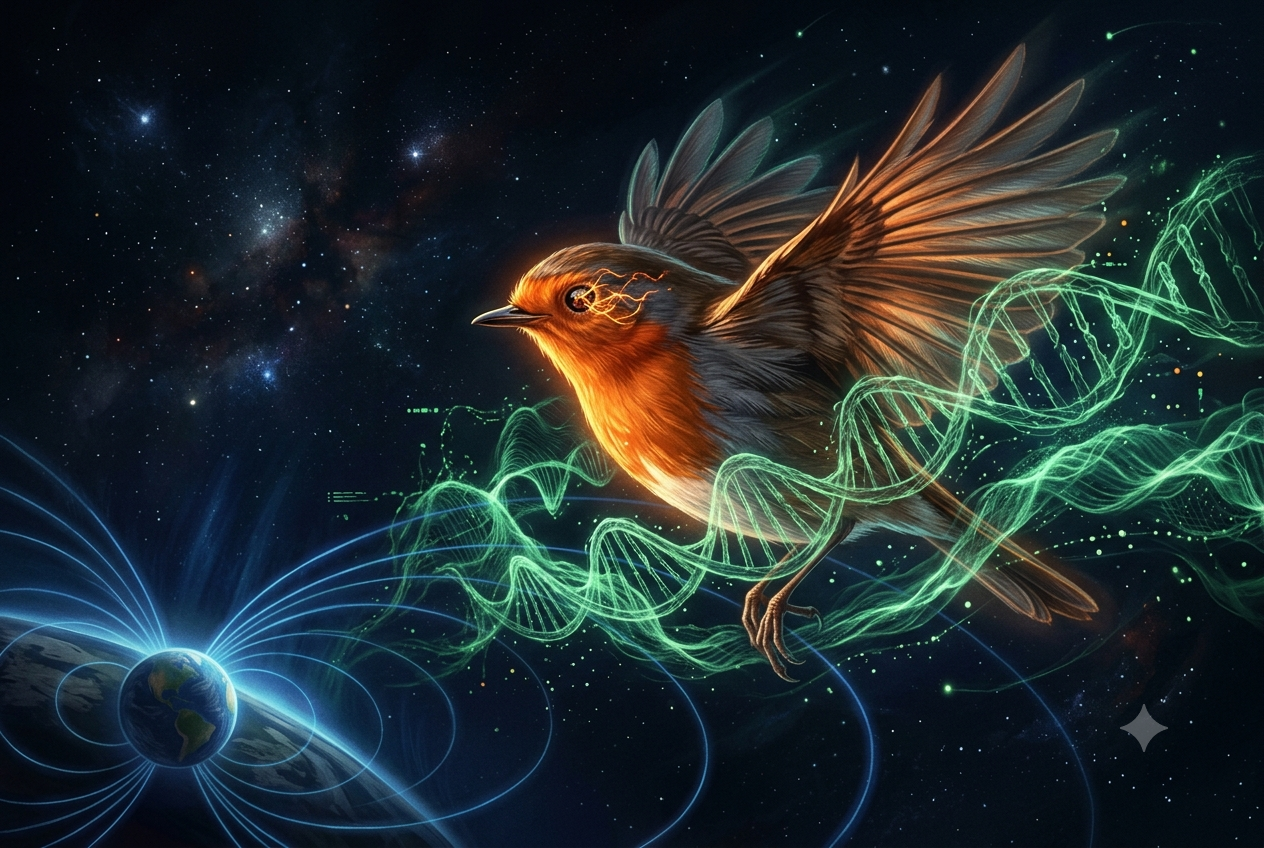
Inside the eyes of migratory birds like the European robin, there are special proteins called cryptochromes. When light hits these proteins, it creates a pair of molecules with unpaired electrons — one in each molecule. These two electrons become quantum entangled: they are linked together even though they are on separate molecules.
Here is the key part: Earth’s magnetic field affects how these entangled electrons behave. Depending on which direction the bird is facing relative to the magnetic field, the chemical reaction inside the cryptochrome either proceeds or slows down. This gives the bird a chemical signal that tells it which way is north — essentially a quantum compass built into its eye.
The bird does not “see” the magnetic field. It feels it chemically, through quantum entanglement, as a kind of brightness or shadow in its visual field. It literally sees the Earth’s magnetic field as part of the image it sees.
Why this matters
If birds evolved quantum-mechanical navigation systems, it tells us two things. First, quantum effects can survive inside warm, wet, noisy biological systems — something physicists long thought was impossible. Second, evolution found and exploited quantum tricks billions of years before we even knew quantum physics existed. Nature is a better quantum engineer than we are.
🌿 2. Photosynthesis — Nature’s Perfect Quantum Computer
Every plant, every tree, every blade of grass on Earth runs on photosynthesis. It is the process that converts sunlight into food — and it is so efficient that our best solar panels are still nowhere close to matching it.
In 2007, scientists at Berkeley made a stunning discovery: photosynthesis uses quantum superposition.
The energy transfer problem
When a photon of light hits a leaf, it creates a tiny packet of energy called an exciton. This exciton needs to travel from the outer part of the photosynthetic complex (where light is absorbed) to the reaction centre (where the energy is actually used). The distance is tiny — a few nanometres — but there are thousands of possible pathways.
A classical system would try each pathway one by one — like someone lost in a maze trying every corridor. Most energy would be wasted as heat along the wrong paths.
But the exciton in a plant does something extraordinary: it travels in quantum superposition, exploring all possible pathways simultaneously. It finds the most efficient route almost instantly — every single time — with near-zero energy wasted. It is like solving the maze by being in every corridor at once.
👃 3. Your Sense of Smell — A Quantum Detector
How do you smell a rose? The standard explanation was simple: smell molecules float into your nose, fit into receptor proteins like a key into a lock, and your brain registers the smell. Shape = smell. Easy.
The problem is, this theory has a serious flaw. There are molecules with completely different shapes that smell identical. And molecules with almost identical shapes that smell completely different. The lock-and-key model alone cannot explain this.
The quantum vibration theory
In 1996, biophysicist Luca Turin proposed something radical: your nose detects the quantum vibration frequency of molecules, not just their shape.
Every molecule vibrates at its own specific set of frequencies — these are determined by the quantum energy levels of its chemical bonds. Turin proposed that smell receptors work using a quantum process called inelastic electron tunneling: an electron tunnels through the smell molecule, but only if the molecule’s vibration frequency matches exactly. If it matches, the receptor fires. If it does not, no smell.
It is like a quantum tuning fork inside your nose — sensing the “music” of each molecule rather than just its shape.
⚡ 4. Enzyme Reactions — Quantum Tunneling Keeps You Alive
We touched on this in our last post, but it deserves its own spotlight in quantum biology.
Your body runs on thousands of chemical reactions every second. Enzymes are the proteins that make these reactions fast enough to keep you alive. Without them, most reactions would take millions of years. With them, they take milliseconds.
For a long time, scientists assumed enzymes worked by lowering the energy needed to get over a reaction barrier — like making a hill smaller so a ball can roll over it. But experiments showed the reactions were happening far too fast — even faster than the lowered-barrier model predicted.
The quantum answer
The missing piece is quantum tunneling. Hydrogen atoms (protons) inside enzyme reactions do not go over the energy barrier. They tunnel straight through it. This is why reactions complete in microseconds instead of hours. Your metabolism is partly powered by particles ignoring the rules of classical physics.
🧬 5. DNA Mutations — Quantum Errors in the Code of Life
Here is a deeply surprising one. Some mutations in DNA — the kind that can eventually lead to cancer or genetic disease — may be caused by quantum tunneling of protons.
How DNA normally works
DNA is a double helix made of two strands connected by base pairs. Each base pair is held together by hydrogen bonds — essentially, hydrogen atoms (protons) sitting between two molecules. The exact position of these protons determines whether the base pair is read correctly by the cell’s copying machinery.
The quantum mutation
In 1963, physicists Per-Olov Löwdin proposed that protons in DNA base pairs could occasionally quantum tunnel from their normal position to an alternative position. This creates what is called a tautomer — a slightly different chemical form of the base pair. If the cell copies this DNA while the proton is in its tunneled position, it reads the wrong base — creating a mutation.
Most of the time these mutations are corrected by DNA repair enzymes. But sometimes they are not. And those uncorrected quantum tunneling events could be the origin of some cancers and hereditary diseases.
🚀 The Future: What Quantum Biology Could Give Us
Quantum biology is still a young field — most scientists did not even take it seriously 20 years ago. Today it is one of the fastest-growing areas in science. Here is what it could lead to in the coming decades:
- 🌱 Quantum solar panels — Designed to mimic photosynthesis, with near-95% efficiency. This alone could solve the world’s energy crisis.
- 🧭 Bio-inspired quantum navigation — Sensors modelled on bird cryptochromes that need no GPS signal, no battery, and work underground or underwater.
- 👃 Quantum smell sensors — Artificial noses that can detect diseases from breath — cancer, diabetes, infections — by reading the quantum vibration fingerprints of molecules.
- 💊 Quantum-targeted cancer drugs — Medicines designed to block quantum tunneling in specific cancer-related enzymes without touching healthy cells.
- 🧬 Mutation prevention — Therapies that reduce the rate of quantum proton tunneling in vulnerable DNA regions — stopping some cancers before they ever start.
- 🤖 Quantum bio-computers — Computers that borrow nature’s own quantum tricks for energy-efficient, ultra-fast processing — going far beyond today’s silicon chips.
Nature spent 3.8 billion years perfecting quantum biology. We have had about 20 years to begin understanding it. The gap between what nature does and what we can build is closing fast.
⚡ Key Takeaways — Tell Your Friends!
- 🐦 Birds navigate using quantum entanglement inside cryptochrome proteins in their eyes — a real biological quantum compass.
- 🌿 Photosynthesis uses quantum superposition to route energy along all possible paths simultaneously — that is why plants are so much more efficient than our solar panels.
- 👃 Your sense of smell may work by detecting the quantum vibration frequencies of molecules through electron tunneling — not just shape.
- ⚡ Enzyme reactions in your body are powered by quantum tunneling — protons pass through energy barriers instead of over them, keeping your metabolism fast enough to sustain life.
- 🧬 Some DNA mutations — potentially leading to cancer — may be caused by quantum tunneling events that shift a proton to the wrong position in a base pair.
- 🔭 Quantum biology is one of the most exciting frontiers in science — nature has been using quantum mechanics for billions of years, and we are only just beginning to understand how.
🌟 Final Thoughts: Life Itself Is Quantum
There is a beautiful irony at the heart of quantum biology. We spent decades thinking quantum physics was an exotic, abstract subject — something that only mattered in cold laboratory experiments far removed from the real world.
And all along, a robin was using it to fly to Africa. A sunflower was using it to feed itself. Your nose was using it to smell a flower. Your enzymes were using it to keep you alive. Your DNA was being shaped — occasionally altered — by it.
Life did not just evolve alongside quantum physics. Life evolved to use it.
The boundary between the quantum world and the living world is not where we thought it was. It was never a boundary at all.
The next time you watch a bird soar overhead on a migration route that crosses continents, or smell the first flowers of spring, or eat a meal — remember that somewhere in the middle of all that beauty, quantum mechanics is quietly at work. 🐦🌸⚛️
💬 Which example surprised you the most? The quantum bird compass, photosynthesis running on superposition, or the idea that some cancers start with a quantum tunneling error in DNA? Tell us in the comments! And share this post with someone who thinks quantum physics has nothing to do with real life. ✨
The secret of the universe is waiting… ✨
We Love Physics – Making the biggest secrets of the cosmos simple, fun, and relevant to your life.