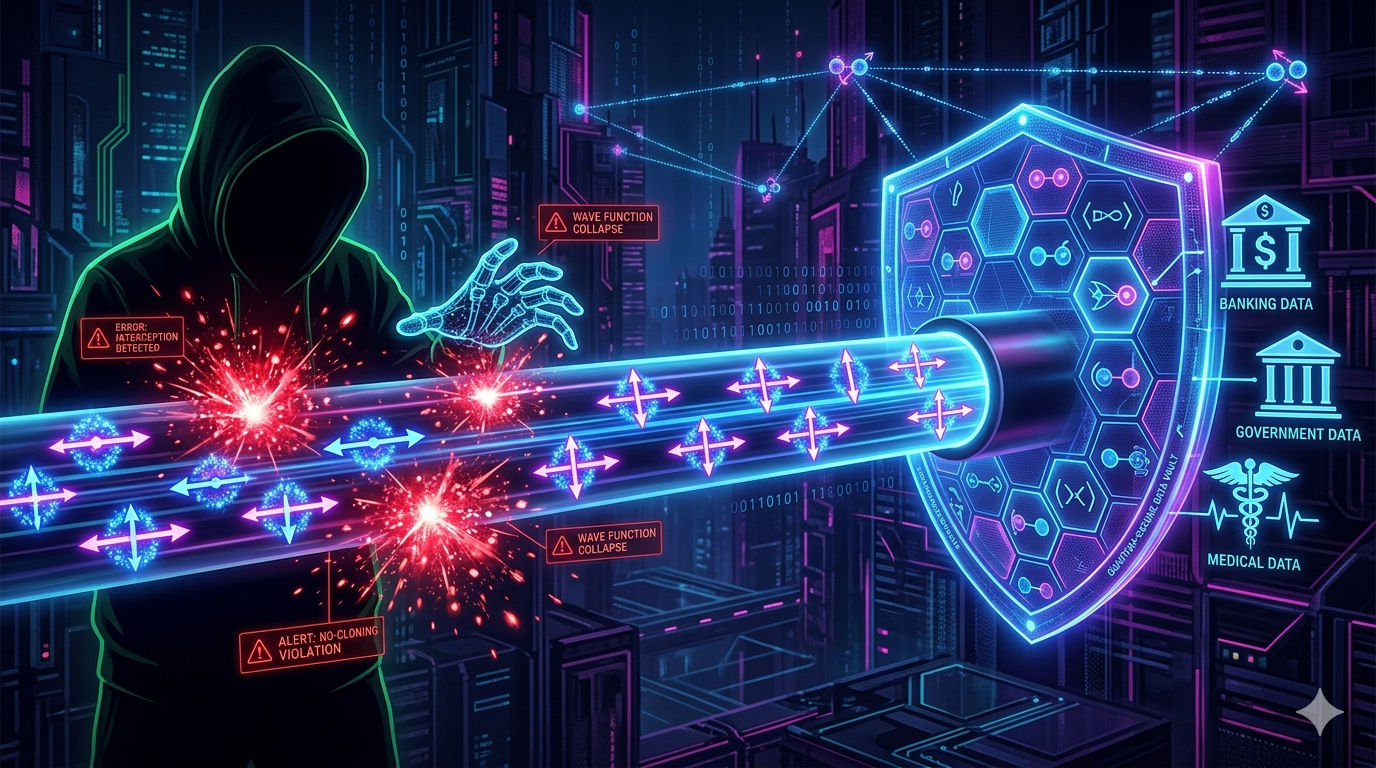
Imagine a hacker trying to steal your online banking password, credit card details, or private messages. Today, they might succeed by breaking complex mathematical codes. But what if the security was guaranteed by the fundamental laws of the universe itself?
That’s exactly what quantum cryptography offers. It uses the strange rules of quantum mechanics — like superposition, entanglement, and wave function collapse — to create codes that are theoretically unbreakable. If anyone tries to spy on the communication, the laws of physics immediately alert the sender and receiver.
Welcome to one of the most important real-world applications of quantum physics in our digital age. At WeLovePhysics.com, we turn complex science into simple, exciting stories. In this detailed guide, you’ll learn what quantum cryptography is, how it actually works, its powerful real-life applications, and why it will be essential for protecting your future in 2026 and beyond.
By the end of this post, you’ll be able to explain quantum cryptography confidently to your friends and family. Let’s dive into this fascinating world where quantum weirdness becomes your best digital bodyguard!
Why We Need Quantum Cryptography Right Now
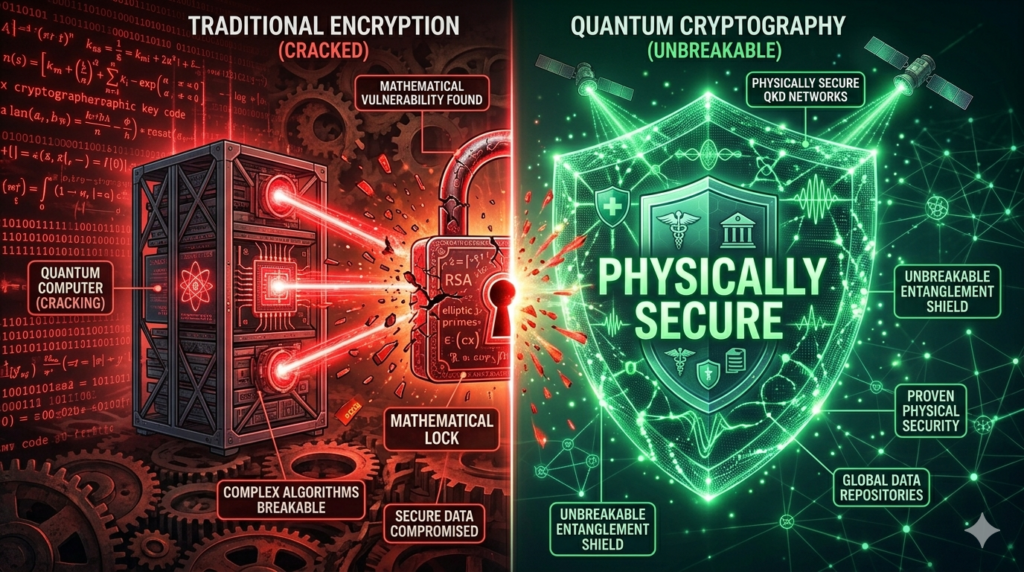
Every day, we send sensitive information online — bank transfers, medical records, personal chats, government secrets, and business deals. Most of this is protected by traditional encryption methods like RSA and ECC. These systems rely on complex math that is very hard (but not impossible) for classical computers to break.
However, quantum computers are advancing rapidly. In the near future, they could crack today’s encryption in minutes. This creates a massive security risk known as the “Q-Day” or “Y2Q” problem.
Quantum cryptography solves this by using the unbreakable laws of physics instead of just mathematics. Any attempt to “look” at the quantum information disturbs it, thanks to the principles we discussed in our earlier post on Wave Function Collapse.
This makes quantum cryptography not just strong — but physically secure.
What Is Quantum Cryptography?
Quantum cryptography is the science of using quantum mechanics to secure communication. The most practical and widely used method is called Quantum Key Distribution (QKD).
QKD doesn’t encrypt the actual message. Instead, it securely distributes a secret “key” (a random string of numbers) between two parties. Once both have this key, they can use it to encrypt and decrypt messages with perfect security.
The beauty lies in this: the security comes directly from quantum physics, not from keeping algorithms secret.
How Quantum Key Distribution (QKD) Works – Explained Simply
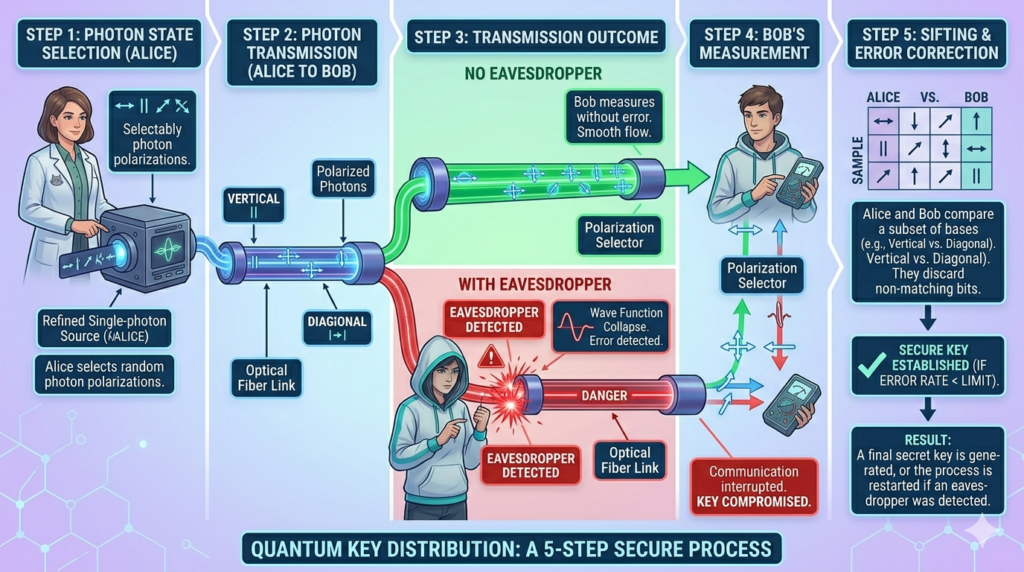
Let’s break it down step by step without heavy math:
- Sending Single Photons
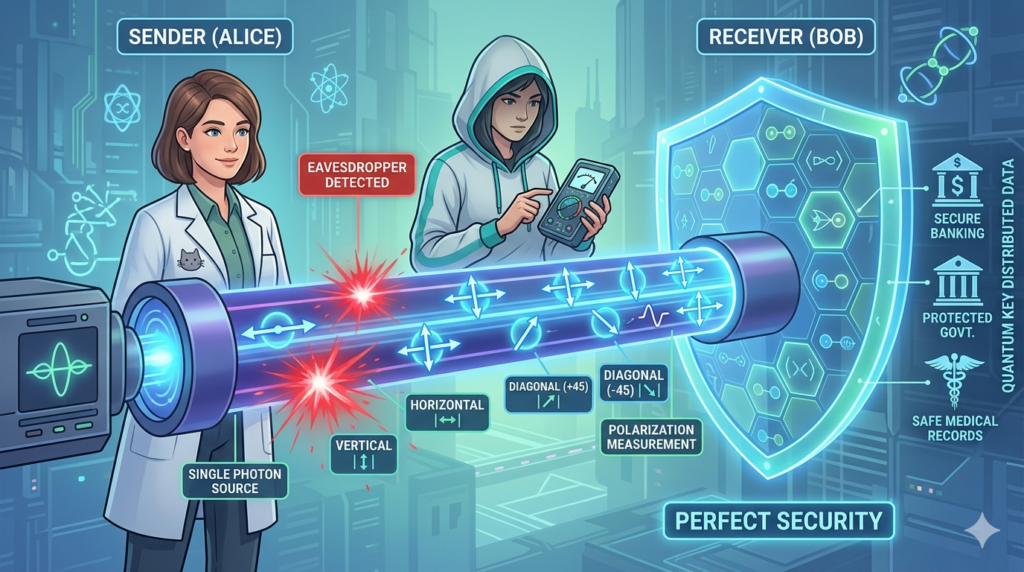
Alice (the sender) sends individual particles of light called photons to Bob (the receiver). Each photon carries information in its quantum property — usually its polarization (the direction it vibrates, like horizontal, vertical, or diagonal). - Superposition and Random Choices
The photons exist in a superposition of states. Alice randomly chooses the basis (way of measuring) for each photon. - Bob Measures the Photons
Bob also randomly chooses how to measure each photon. Sometimes he chooses the correct basis, sometimes not. - Public Comparison (But Not the Key)
Alice and Bob publicly compare which basis they used (but not the actual measurement results). They keep only the photons where their bases matched. This becomes their shared secret key. - The Magic of Detection
Here’s the most important part:
If an eavesdropper (Eve) tries to intercept and measure the photons, she disturbs their quantum state. According to quantum mechanics, measuring a quantum particle causes its wave function to collapse. This introduces errors in the key. Alice and Bob can detect these extra errors and know someone is listening. They simply discard the key and try again.
This process is often demonstrated using the BB84 protocol, developed in 1984 by Charles Bennett and Gilles Brassard. It was the first practical quantum cryptography protocol.
The Role of Quantum Entanglement in Advanced Systems
Some advanced quantum cryptography systems use quantum entanglement (the “spooky action at a distance” we covered in earlier posts). Entangled photons remain connected no matter how far apart they are. Measuring one instantly affects the other. This creates even stronger correlations that are impossible for an eavesdropper to fake without detection.
This connects beautifully to our previous articles on Quantum Entanglement and Wave Function Collapse.
Real-Life Applications of Quantum Cryptography
Quantum cryptography is no longer just theory. It’s being used and tested around the world in 2026:
1. Secure Government and Military Communications
Governments are among the first adopters. Countries like China, the USA, and several European nations have built quantum communication networks for highly sensitive information.
In 2016, China launched the Micius satellite, which successfully demonstrated quantum key distribution from space to ground stations — a major milestone.
2. Banking and Financial Transactions
Banks are testing quantum-secured links to protect massive money transfers and customer data. Any interception would be instantly detected, giving banks ultimate confidence in their systems.
3. Healthcare and Medical Data Protection
Medical records contain extremely private information. Quantum cryptography can secure the transfer of patient data between hospitals, ensuring complete privacy and compliance with strict regulations.
4. Critical Infrastructure Protection
Power grids, water systems, and transportation networks are increasingly targeted by cyberattacks. Quantum-secured communication can protect the control systems that keep our modern world running.
5. The Future Quantum Internet
The ultimate vision is a global Quantum Internet where entanglement and QKD create an unhackable network. Information would be transmitted with quantum security from one end of the world to another. Several countries are actively building quantum networks in major cities.
6. Protecting Against Future Quantum Computers
Even if someone builds a powerful quantum computer tomorrow, quantum cryptography remains safe because its security is based on physics, not mathematics that a quantum computer could solve.
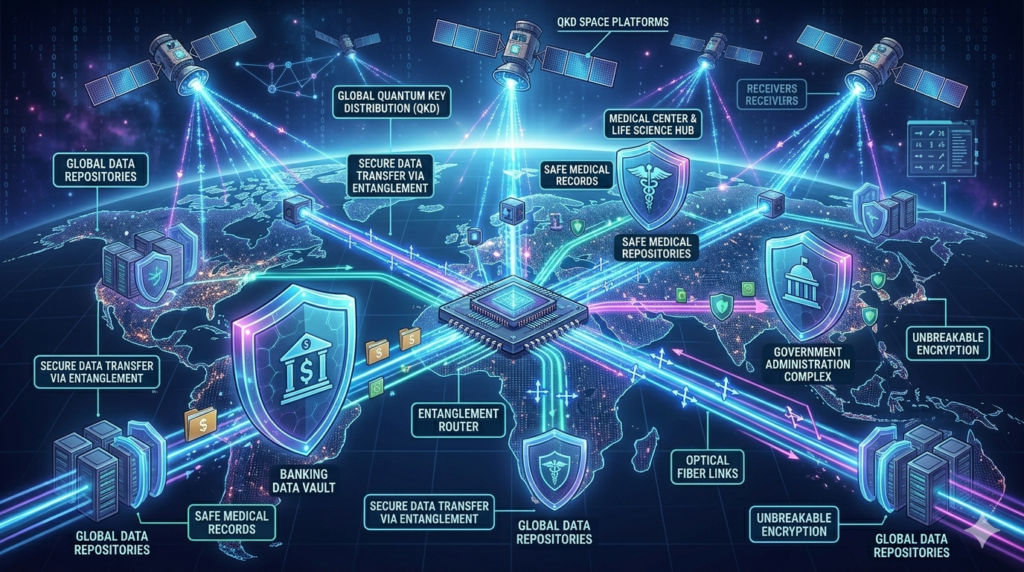
Real-World Deployments in 2026/2027
- China: Has the world’s longest quantum communication backbone (over 2,000 km) connecting Beijing and Shanghai.
- Europe: The EuroQCI project is building a quantum communication infrastructure across the European Union.
- USA: Companies and research labs are deploying quantum links for defense and finance.
- Commercial Services: Companies like ID Quantique (Switzerland) and Toshiba are already selling commercial QKD systems to businesses and governments.
Challenges Facing Quantum Cryptography
While powerful, quantum cryptography still faces some hurdles:
- Distance Limitations: Photons get absorbed or scattered over long distances in regular optical fibers. Solutions include quantum repeaters and satellite-based systems.
- Cost: Current systems are expensive, though prices are dropping rapidly.
- Integration: Making quantum cryptography work smoothly with existing internet infrastructure.
- Speed: Current QKD systems are slower than classical encryption, but improvements are happening fast.
Despite these challenges, the technology is maturing quickly, and hybrid systems (combining classical and quantum methods) are already practical.
Why Quantum Cryptography Matters to You in 2026/2027
Even if you’re not a government official or banker, quantum cryptography will protect your daily digital life:
- Safer online banking and shopping
- More private messaging and video calls
- Better protection of your medical and personal data
- Increased trust in digital systems as quantum computers become more powerful
In short, quantum cryptography is your future digital shield.
Key Takeaways You Can Share
- Quantum cryptography uses the laws of physics (especially wave function collapse) to detect eavesdroppers instantly.
- Quantum Key Distribution (QKD) allows two parties to share a perfectly secure secret key.
- It relies on single photons, superposition, polarization, and entanglement.
- Major applications include government communication, banking, healthcare, and the future Quantum Internet.
- It provides protection against future quantum computers that could break today’s encryption.
- The technology is already being deployed in real networks around the world in 2026.
Final Thoughts: Physics as the Ultimate Security Guard
Quantum cryptography is a perfect example of how the “weird” rules of the quantum world — things that once seemed purely theoretical — are now solving some of our most pressing real-world problems.
The same principles that make particles behave strangely in the double-slit experiment are now guarding our most valuable digital assets.
As we continue this quantum journey at WeLovePhysics.com, remember: the universe gives us not only beautiful mysteries but also powerful tools to build a safer future.
What do you think? Would you feel safer knowing your bank uses quantum cryptography? Have you heard about any quantum security news lately? Share your thoughts in the comments below!
If you found this post helpful, please share it with someone who cares about online privacy and security.
Related Articles You’ll Love:
- Quantum Entanglement Explained: Spooky Action at a Distance
- Quantum Computing in 2026: From Hype to Real Applications
- 10 Real-Life Applications of Quantum Physics That Impact Your Daily Life
- Wave Function Collapse: What Really Happens When You Measure a Quantum Particle
The secret of the universe is waiting… ✨
We Love Physics – Making the biggest secrets of the cosmos simple, fun, and relevant to your life.