15-18 min read | Applications of Quantum Physics
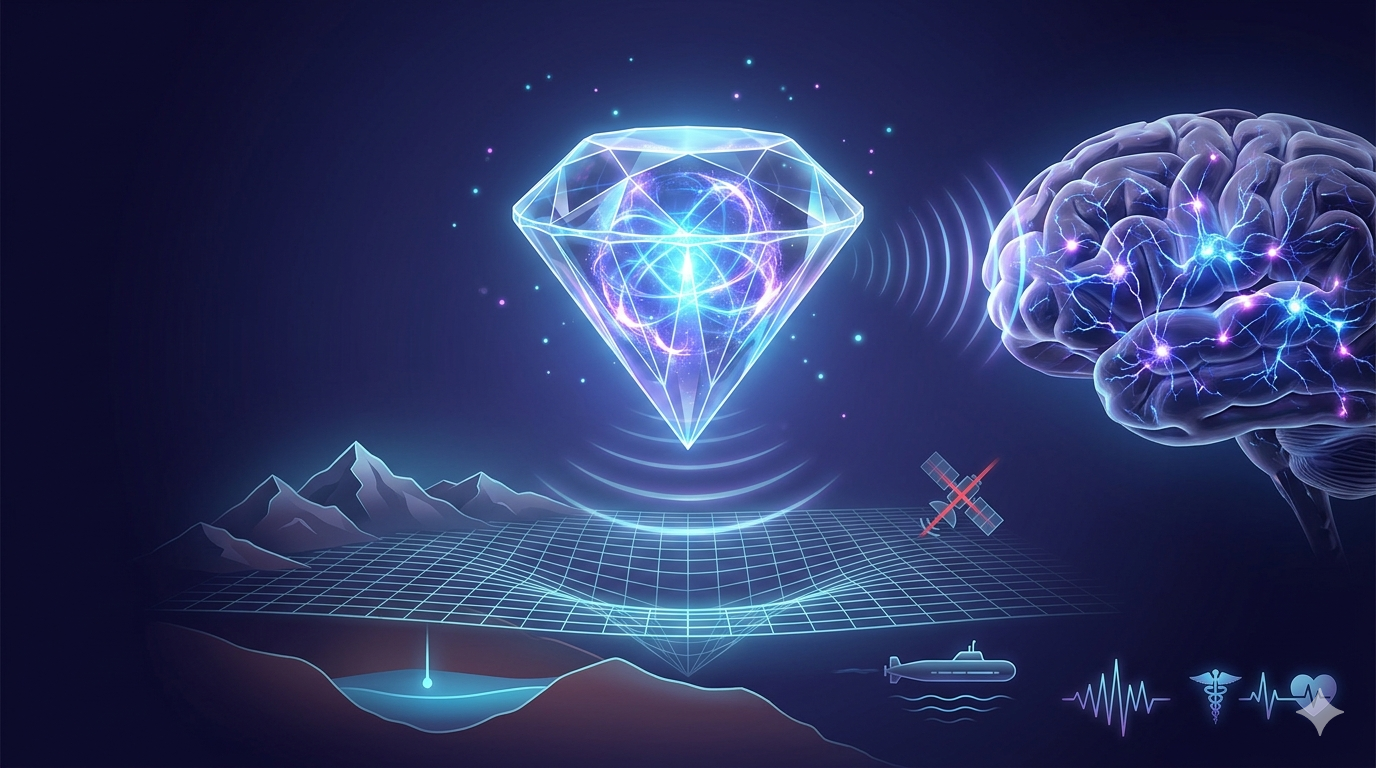
Have you ever felt lost when your phone’s GPS stops working in a tunnel, underground parking, or during a storm? Now imagine a device so sensitive it can track your exact position for months without any satellite signal, detect a single neuron firing in your brain, or sense underground water reserves from the surface.
This isn’t science fiction — it’s happening right now with quantum sensors. These incredible devices use the strange rules of quantum physics (superposition, entanglement, and quantum spin) to measure the world with unbelievable precision. They are already moving from labs into real-world use in 2026, promising to transform navigation, medicine, environmental monitoring, and more.
At WeLovePhysics.com, we love turning complex science into simple, exciting stories. In this detailed guide, you’ll discover exactly what quantum sensors are, how they work (without heavy math), their mind-blowing real-life applications, and why they matter to your daily life. By the end, you’ll be able to explain quantum sensors confidently to friends and family.
Let’s explore one of the most practical and exciting applications of quantum mechanics today!
What Exactly Are Quantum Sensors?
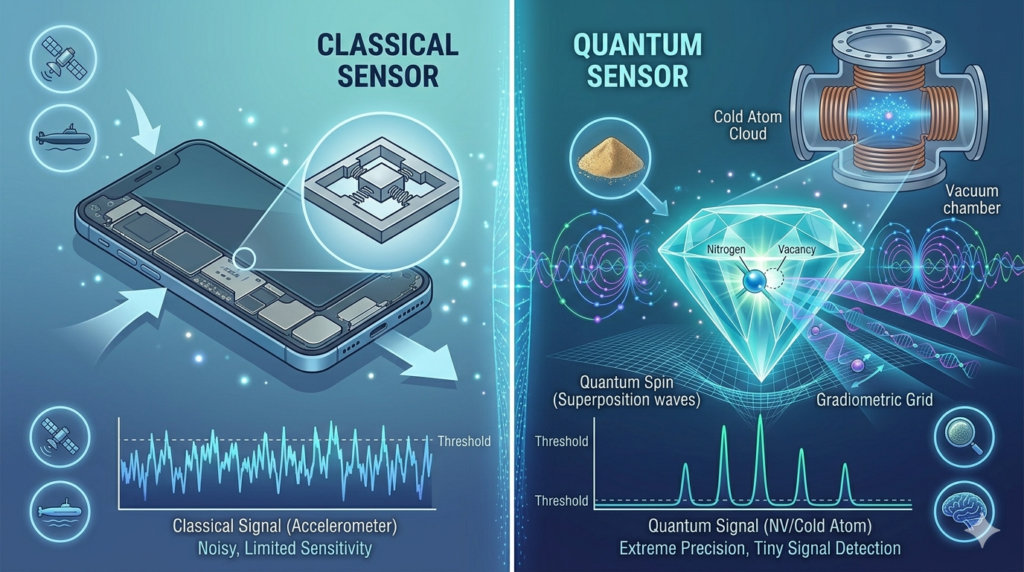
Classical sensors (like those in your smartphone) measure things using everyday physics — voltage changes, mechanical movement, or light intensity. They are good, but limited.
Quantum sensors go much deeper. They use individual atoms, electrons, or special defects in materials as their “measuring tools.” Because these tiny quantum systems follow quantum rules, they can detect incredibly small changes in gravity, magnetic fields, time, acceleration, or temperature — changes that classical sensors simply miss.
Think of it like this:
A classical thermometer tells you the temperature of a room.
A quantum sensor can feel the tiny heat from a single molecule or detect temperature differences at the nanoscale.
Quantum sensors achieve this by putting particles into superposition (existing in multiple states at once) or using entanglement (linking particles so one instantly affects the other). When something in the environment disturbs these delicate quantum states, scientists can measure it with extreme accuracy.
The best part? Many modern quantum sensors now work at room temperature and are becoming smaller and more portable.
The Quantum Magic Behind the Sensors
Here are the main quantum heroes making this possible:
- Superposition
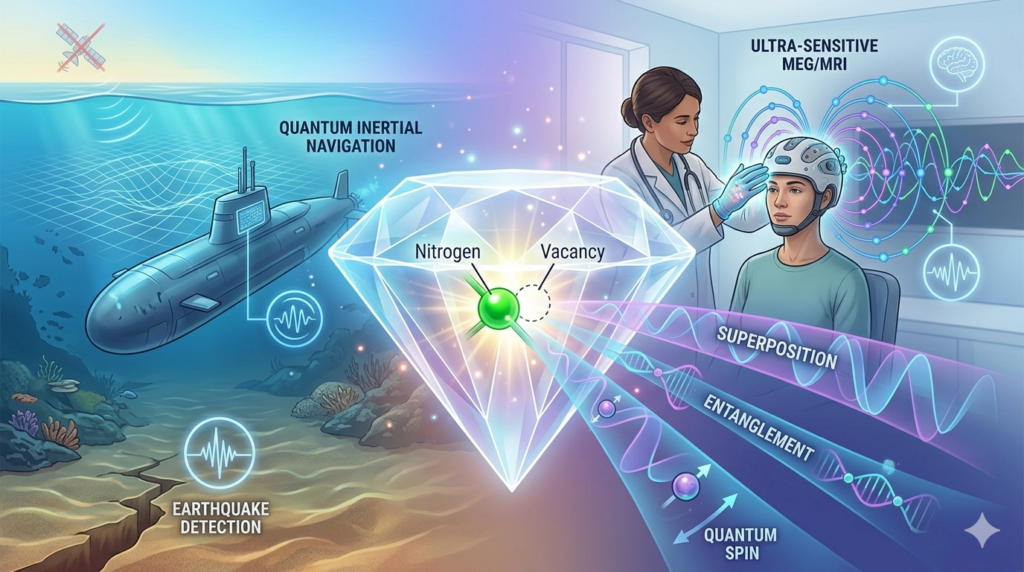
A particle can be in multiple states simultaneously. This allows the sensor to “try” many possibilities at once, making it far more sensitive to tiny signals. - Entanglement
Two or more particles become linked. Measuring one instantly gives information about the other. This helps cancel out noise and achieve cleaner, more precise measurements. - Quantum Spin & Wave Behavior
Particles have an intrinsic property called spin. Changes in magnetic fields or gravity affect this spin, which we can read like a tiny compass needle.
Two standout technologies you’ll hear about often:
- Cold Atom Sensors (using laser-cooled atoms): Atoms are slowed down to near absolute zero, behaving like waves. Interference patterns reveal tiny accelerations or gravity changes.
- Nitrogen-Vacancy (NV) Centers in Diamond: A special defect in diamond (a nitrogen atom next to a missing carbon atom) acts as an atomic-sized sensor. These work at room temperature, are very stable, and can be used in tiny chips or even inside living cells.
These principles connect directly to concepts we’ve covered before, like wave function collapse (when we measure the sensor) and quantum superposition.
A Brief History: From Theory to Real Devices
The foundations go back to the early days of quantum mechanics. Atomic clocks (a type of quantum sensor) have been around since the 1950s and already power GPS accuracy.
The real explosion came in the last 15–20 years with better lasers, diamond engineering, and funding for quantum technologies. In 2026, the quantum sensors market is growing fast — expected to reach billions in the coming years — with companies and governments investing heavily in navigation, healthcare, and climate tech.
Portable quantum gravimeters and magnetometers are now being tested in real environments, from volcanoes to hospitals.
1. Quantum Navigation: Goodbye to GPS Jamming and Blackouts
One of the most urgent applications is GPS-free navigation.
GPS signals are weak and easily jammed or blocked. Quantum inertial sensors and gravimeters solve this by measuring acceleration and gravity changes continuously.
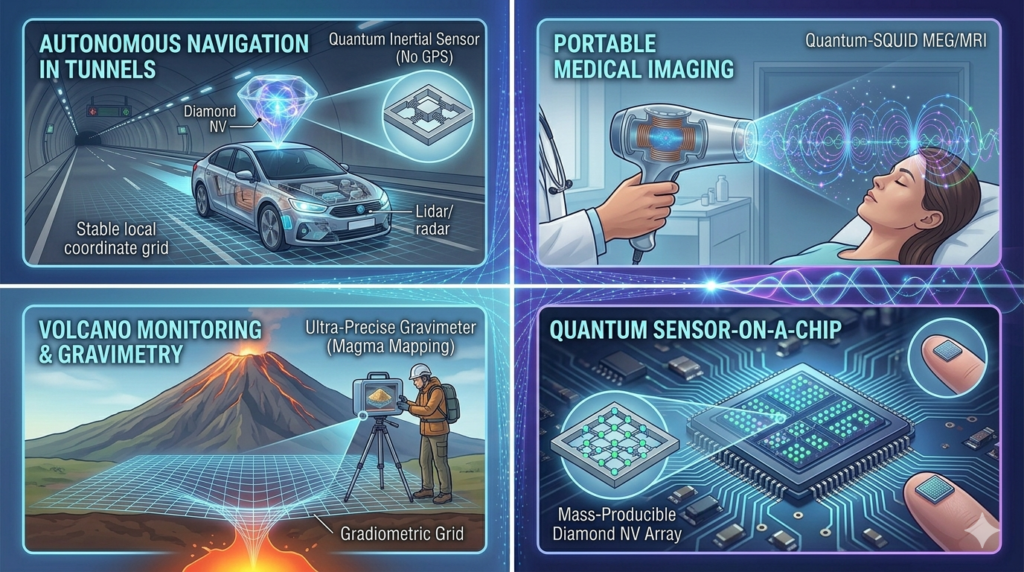
- How it works: Clouds of ultra-cold atoms act as ultra-precise accelerometers. By tracking how atoms fall or interfere, the system knows exactly how it has moved — even deep underwater or in tunnels.
- Real examples: Submarines and military aircraft already test these. Civilian uses include autonomous cars, drones, and ships that need reliable positioning anywhere.
- Real-world impact: A UK team demonstrated a portable quantum compass. In Australia and the US, similar systems are advancing rapidly. Imagine your future car or phone never losing location accuracy.
This could save lives in emergencies, improve logistics, and make transport safer.
2. Medical Marvels: Seeing the Brain and Body Like Never Before
Quantum sensors are opening new doors in healthcare because they can detect incredibly weak magnetic fields produced by the brain and heart.
- Quantum MEG (Magnetoencephalography): Traditional brain scanners require patients to stay perfectly still in huge machines. Quantum magnetometers (especially optically pumped or NV-diamond ones) are wearable. Patients can move naturally while doctors map brain activity in real time. This helps with epilepsy, Alzheimer’s, dementia, and stroke recovery.
- Heart Monitoring: Quantum sensors detect the heart’s tiny magnetic fields for better diagnosis of arrhythmias.
- Single-Molecule Imaging: Researchers have used quantum techniques to image individual molecules, which could revolutionize drug discovery and early cancer detection.
- Future wearable quantum health monitors: Imagine a hat or patch that continuously tracks your brain health non-invasively.
These tools are gentler (no strong magnetic fields like traditional MRI in some cases) and more sensitive, potentially catching diseases earlier.
3. Environmental Monitoring & Geophysics: Feeling the Earth’s Hidden Secrets
Quantum gravimeters measure tiny variations in Earth’s gravity caused by underground density differences.
- Finding water and minerals: They can map aquifers, detect mineral deposits, or find hidden voids and tunnels with high accuracy.
- Volcano and earthquake warning: Monitoring gravity changes on volcanoes like Mt. Etna helps predict eruptions.
- Climate change tracking: Measuring ice melt, groundwater levels, and carbon storage leaks more precisely.
- Civil engineering: Checking the health of bridges, dams, and infrastructure by detecting tiny shifts.
One portable quantum gravimeter can do continuous measurements for years — something classical devices struggle with.
4. Defense, Security & Other Applications
- Quantum Radar: Harder to detect and jam than traditional radar.
- Magnetic Anomaly Detection: Finding submarines or buried objects.
- Precision Timing: Atomic clocks (already quantum) keep global internet, finance, and power grids synchronized. Quantum versions are even better.
- Oil & Gas Exploration: More efficient resource mapping with less environmental impact.
Challenges on the Road to Everyday Use
Quantum sensors are powerful but not perfect yet. Many still need careful cooling or shielding. Size, cost, and robustness in real-world conditions are improving quickly, but commercialization takes time. The good news? 2026 is seeing rapid progress in portable, room-temperature devices, especially those using diamond NV centers.
Why Quantum Sensors Matter to You in Daily Life
Even if you don’t notice them, quantum sensors are quietly making your world better:
- More accurate weather forecasts and disaster warnings.
- Safer travel with reliable navigation.
- Better and earlier medical diagnoses.
- Smarter management of natural resources and climate efforts.
They prove once again that “weird” quantum effects aren’t just lab curiosities — they solve real problems and improve lives.
Key Takeaways You Can Share
- Quantum sensors use superposition, entanglement, and spin for ultra-precise measurements.
- They outperform classical sensors in gravity, magnetic fields, acceleration, and time.
- Major applications include GPS-free navigation, brain imaging, environmental monitoring, and defense.
- Technologies like cold atoms and NV centers in diamond are leading the way.
- The field is growing fast in 2026, with practical devices already in trials and early commercial use.
- Quantum sensors show how fundamental physics directly improves technology and society.
Final Thoughts: The Quantum Sixth Sense
Quantum sensors give humanity a new “sixth sense” — the ability to feel tiny forces and fields we never could before. They bridge the gap between the strange quantum world and practical, everyday benefits.
As we continue exploring quantum physics here at WeLovePhysics.com, remember: the same rules that make particles behave weirdly in double-slit experiments are now helping doctors see inside brains and pilots navigate without satellites.
The universe’s deepest secrets are becoming our most useful tools.
Which application excites you most — quantum brain imaging, GPS-free navigation, or underground Earth sensing? Tell us in the comments below! Have you experienced GPS failure and wished for something better? Share your story.
If you enjoyed this post, share it with a friend curious about how quantum physics touches real life. Check these related articles:
- 10 Real-Life Applications of Quantum Physics That Impact Your Daily Life
- Wave Function Collapse: What Really Happens When You Look at a Quantum Particle
- Quantum Biology: How Nature Uses Quantum Tricks
The secret of the universe is waiting… ✨
We Love Physics – Making the biggest secrets of the cosmos simple, fun, and relevant to your life.