14–17 min read | Applications of Quantum Physics
Have you ever had an MRI scan? Or perhaps a family member has been through cancer treatment that used a targeted drug?
Here is something most people don’t know: quantum physics made all of it possible.
The same “strange rules” that make particles behave weirdly — the rules of the quantum world — are quietly working inside hospital machines, saving millions of lives every year. And the best is still coming.
In this post, we’re going to walk through the amazing story of how quantum physics powers modern medicine. We’ll keep it simple, visual, and exciting. By the end, you’ll never look at a hospital scanner the same way again.
Let’s go inside the quantum body. 🧬
🔬 First: Why Does Quantum Physics Matter in Medicine?
Quantum physics is the science of the very small — atoms, electrons, protons, and the energy they carry. For a long time, people thought it was just a topic for theoretical physicists with chalkboards full of equations.
But here’s the truth: your body is made of atoms. And atoms follow quantum rules. So understanding those rules gives doctors and scientists powerful tools to look inside the body, find disease, and even fix it — without cutting you open.
🧠 Think of it this way:
Classical medicine is like trying to understand a city by looking at it from far above in a plane.
Quantum medicine is like zooming in to see every single brick, wire, and pipe inside every building.
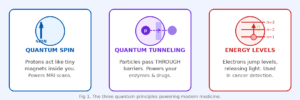
Three quantum ideas power most of what we’ll talk about today:
- Quantum Spin — Particles like protons have a tiny magnetic property called “spin.” We can use magnetic fields to detect and read this spin. This is how MRI works.
- Quantum Tunneling — A particle can “tunnel” through a barrier it shouldn’t be able to cross. This happens inside enzymes in your body, and scientists use it to design better medicines.
- Quantum Energy Levels — Electrons can only exist at certain energy levels inside an atom. When they move between levels, they release or absorb light. Doctors use this to detect molecules and even cancer cells.
🧲 1. MRI Scans — Quantum Spin at Work Inside You
If you’ve ever had an MRI scan, you’ve experienced quantum physics firsthand. You just didn’t know it!
What is an MRI?
MRI stands for Magnetic Resonance Imaging. It creates detailed pictures of the inside of your body — brain, spine, joints, organs — without using harmful X-rays.
How does it work? (Simply put)
Your body is mostly water. Water contains hydrogen atoms. Each hydrogen atom has a proton in its center. And here’s the quantum magic: every proton has a property called “spin” — it behaves like a tiny bar magnet, always pointing in some direction.
When you lie inside an MRI machine, a very powerful magnetic field turns on. This force aligns all the hydrogen protons in your body in one direction — like soldiers standing to attention.
Then the machine sends a pulse of radio waves at exactly the right quantum frequency. This “flips” the protons out of alignment. When the radio wave turns off, the protons snap back — and as they do, they release a tiny signal.
Different tissues (muscle, fat, bone, water) snap back at different speeds. A computer reads all these signals and builds a precise map — a beautiful image of the inside of your body.
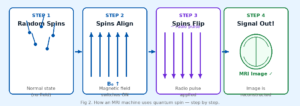
🤯 Mind-blowing fact: The MRI machine in your hospital uses quantum effects happening inside billions of protons simultaneously — all in your body, all in real time. The quantum world is inside you right now.
Why does this matter?
MRI scans can detect brain tumors, spinal damage, torn ligaments, heart disease, and dozens of other conditions — all without a single cut or X-ray. Over 100 million MRI scans are performed worldwide every year. Quantum physics is literally saving that many lives, annually.
☢️ 2. PET Scans — When Antimatter Meets Quantum Physics
PET stands for Positron Emission Tomography. This one sounds very sci-fi, but it’s happening in hospitals right now.
The story of the positron
A positron is the antimatter twin of an electron. It has the same mass as an electron, but the opposite charge. When a positron meets an electron — boom! Both particles annihilate each other and release two gamma rays (very high-energy photons), shooting out in exactly opposite directions at the speed of light.
Doctors inject a tiny amount of a radioactive substance into a patient. As it travels through the body and is absorbed by active cells, it emits positrons. Those positrons annihilate with nearby electrons and release gamma ray pairs. The PET scanner detects those gamma rays and works out exactly where inside the body they came from.

Because cancer cells are very active, they absorb more of the radioactive substance. So PET scans can show exactly where cancer is growing in the body — often before a tumor is even big enough to feel or see on a regular scan.
💡 Real impact: PET scans are now used for early detection of cancer, Alzheimer’s disease, heart disease, and epilepsy. They’re one of the most powerful diagnostic tools in medicine — and they exist because of quantum annihilation of matter and antimatter.
🧬 3. Quantum Tunneling — The Physics of Life’s Enzymes
This one will blow your mind. Quantum tunneling doesn’t just happen in labs or machines. It’s happening inside your body right now.
What is quantum tunneling?
In the everyday world, if a ball rolls toward a wall, it either gets over it (if it has enough energy) or bounces back. There’s no in-between.
But in the quantum world, a particle — like an electron or a proton — can actually pass straight through a barrier even without enough energy to get over it. It’s called tunneling. It sounds impossible, but it’s real, measurable, and essential for life.
Tunneling inside your body
Enzymes are proteins in your body that speed up chemical reactions — without enzymes, most reactions would take millions of years. Scientists have discovered that many enzymes work by using quantum tunneling to transfer protons (hydrogen nuclei) between molecules at speeds that classical physics cannot explain.
In other words, your metabolism — the set of chemical reactions that keep you alive — relies on quantum tunneling to work fast enough to sustain life.
🌿 Fun Quantum Biology Fact: Photosynthesis — how plants turn sunlight into food — also uses quantum effects! Electrons in plant cells travel through protein complexes using quantum superposition to find the most efficient path. Nature has been doing quantum computing for billions of years.
Quantum tunneling in drug discovery
Understanding tunneling helps scientists design better drugs. When designing a molecule that will interact with a specific enzyme, chemists now use quantum calculations to predict how hydrogen atoms will tunnel between chemical groups. This means drugs can be designed to be more precise, with fewer side effects.
💡 4. Quantum Dots — Glowing Nanoparticles That Find Cancer
Imagine being able to tag a single cancer cell with a glowing particle so tiny it’s invisible to the naked eye — and then track it under a microscope with perfect accuracy. This is what quantum dots can do.
What are quantum dots?
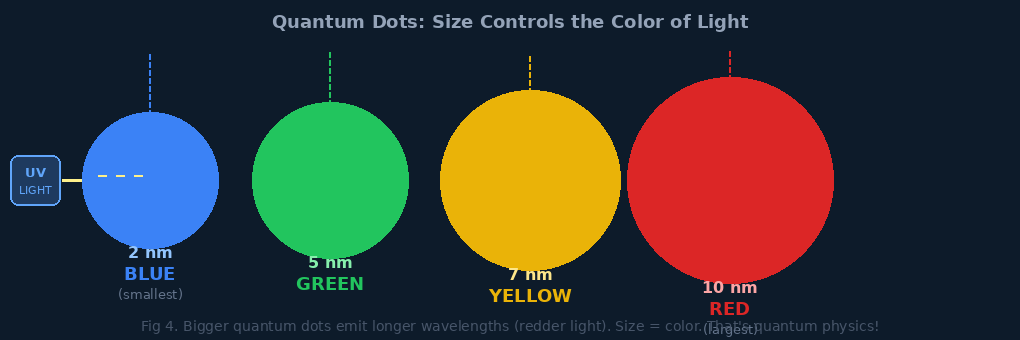
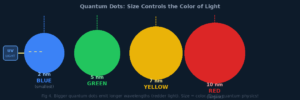
Quantum dots are tiny crystals — just 2 to 10 nanometers in size (a human hair is about 80,000 nanometers wide). They’re so small that quantum effects take over their behavior. When you shine light on them, they absorb it and then emit their own light in a very specific color — controlled by their size.
A smaller quantum dot glows blue. A slightly bigger one glows green. A larger one glows red. Scientists can tune the color precisely by adjusting the size of the dot — something that’s impossible with normal chemicals.
How they’re used in medicine
- Cancer detection: Quantum dots can be attached to antibodies that specifically target cancer cells. Injected into a patient, they “find and tag” tumors, making them glow for imaging under special cameras — allowing surgeons to see exactly where to cut.
- Tracking drugs: Researchers can attach quantum dots to drug molecules and watch, in real time, how they move through the body and enter cells.
- Better diagnostics: Quantum dot-based tests can detect disease proteins at extremely low concentrations — catching diseases earlier than conventional tests.
💊 5. Quantum Computing in Drug Discovery — The Coming Revolution
Designing a new drug is incredibly hard. A drug molecule must fit perfectly into a protein (like a key into a lock) to work. The problem? Molecules behave according to quantum mechanics, and simulating quantum behavior on a regular computer is almost impossible for large molecules. The calculation becomes too complex, too fast.
Quantum computers don’t have this problem. They naturally operate on quantum principles, so they can simulate molecules with incredible accuracy.
⚗️ Real example: In 2023–2025, pharmaceutical companies including Roche, Pfizer, and AstraZeneca began partnering with quantum computing companies (IBM, Google, IonQ) to simulate protein folding and drug-molecule interactions. What might take a classical supercomputer years could take a quantum computer days — or hours.
Diseases that have no good treatment today — Alzheimer’s, antibiotic-resistant bacteria, certain rare cancers — may finally meet their match when quantum computers can properly simulate the chemistry involved.
🔭 6. Quantum Imaging — Seeing Beyond What Light Allows
Normal cameras and microscopes are limited by the wavelength of light. Once you try to image something smaller than the wavelength you’re using, the image becomes blurry. This is called the “diffraction limit.”
Quantum imaging breaks this limit. By using entangled photons (pairs of light particles that are quantum-linked), scientists can produce images with much higher resolution than ordinary light allows — and with far less light exposure, meaning less radiation damage to biological samples.
This is already being used in research labs to image cell structures and is moving toward clinical use for delicate procedures where minimizing radiation exposure is critical — like imaging a developing embryo.
🚀 Imagine the Future: What’s Coming in Quantum Medicine
Close your eyes and imagine yourself 20–30 years from now. Here’s what quantum medicine might look like:
- 🩺 Wearable quantum health monitors — A thin patch on your skin constantly monitors your brain chemistry, heart rhythms, and early cancer markers using quantum sensors. No blood tests needed.
- 💊 Quantum-designed drugs — Medicines built atom by atom using quantum computers. Each drug perfectly shaped for your unique biology. Almost zero side effects.
- 🏥 Real-time quantum surgery — Surgeons wearing AR glasses that show a live quantum dot “map” of every cancer cell in a tumor, allowing complete removal with zero healthy tissue damaged.
- 🧬 Quantum gene therapy — Quantum-level understanding of DNA errors allows correction of faulty genes with precision that today seems like magic.
- 🔬 Single-molecule diagnostics — A drop of blood can be analyzed for thousands of disease markers simultaneously using quantum optical sensors. Early enough to stop most diseases before they start.
None of this is fantasy. Every single one of these is being actively researched right now. The question is not if — it’s when.
⚡ Key Takeaways — Share These With a Friend!
- MRI machines use quantum spin of hydrogen protons to build detailed images of your body — no X-rays needed.
- PET scans use matter-antimatter annihilation (positrons) to find cancer and disease in the body.
- Quantum tunneling happens inside your enzymes right now — it’s what makes your metabolism fast enough to sustain life.
- Quantum dots are nanoparticles that can tag and light up cancer cells, guiding surgeons and enabling earlier detection.
- Quantum computers are beginning to simulate drug molecules far better than regular computers, pointing toward medicines for Alzheimer’s, cancer, and antibiotic resistance.
- Quantum imaging can break the diffraction limit — seeing smaller things with less radiation than ever before.
- The future of medicine is quantum — and it’s already here, in hospitals around the world.
🌟 Final Thoughts: The Quantum Doctor Is Already Here
There is something beautiful about this story. Quantum physics — born from century-old arguments about whether cats could be alive and dead at the same time, about what electrons “really are” — has grown into one of humanity’s most powerful tools for healing.
Every time a doctor reads an MRI scan, quantum mechanics speaks. Every time a PET scan finds a tumor early enough to save a life, antimatter does the work. Every time an enzyme speeds up a reaction in your body, quantum tunneling quietly powers the process.
We didn’t tame the quantum world. We learned to listen to it. And in listening, we built machines that see inside the human body with the eyes of physics itself.
The next time you or someone you love walks into a hospital — look around. Quantum physics is everywhere in that building, quietly doing its job. And it’s only going to do more.
💬 Which quantum medical technology amazes you the most? MRI scans, quantum dots finding cancer, or the idea of quantum-designed drugs? Tell us in the comments below! And if you know someone who has had an MRI or PET scan, share this post with them — they’ll never think of it the same way again. ✨
Continue Your Quantum Journey:
- Quantum Sensors Explained: How They Detect Gravity, Brain Waves & Earthquakes
- Quantum Cryptography: Unbreakable Codes Powered by Quantum Physics
- Quantum Entanglement – Spooky Action at a Distance
- Quantum Computing: From Science Fiction to Reality
- 10 Real-Life Applications of Quantum Physics That Impact Your Daily Life
The secret of the universe is waiting… ✨
We Love Physics – Making the biggest secrets of the cosmos simple, fun, and relevant to your life.