Quantum physics often feels strange, even for scientists. One idea that surprises many people is quantum superposition. It suggests that particles can exist in several states at the same time.
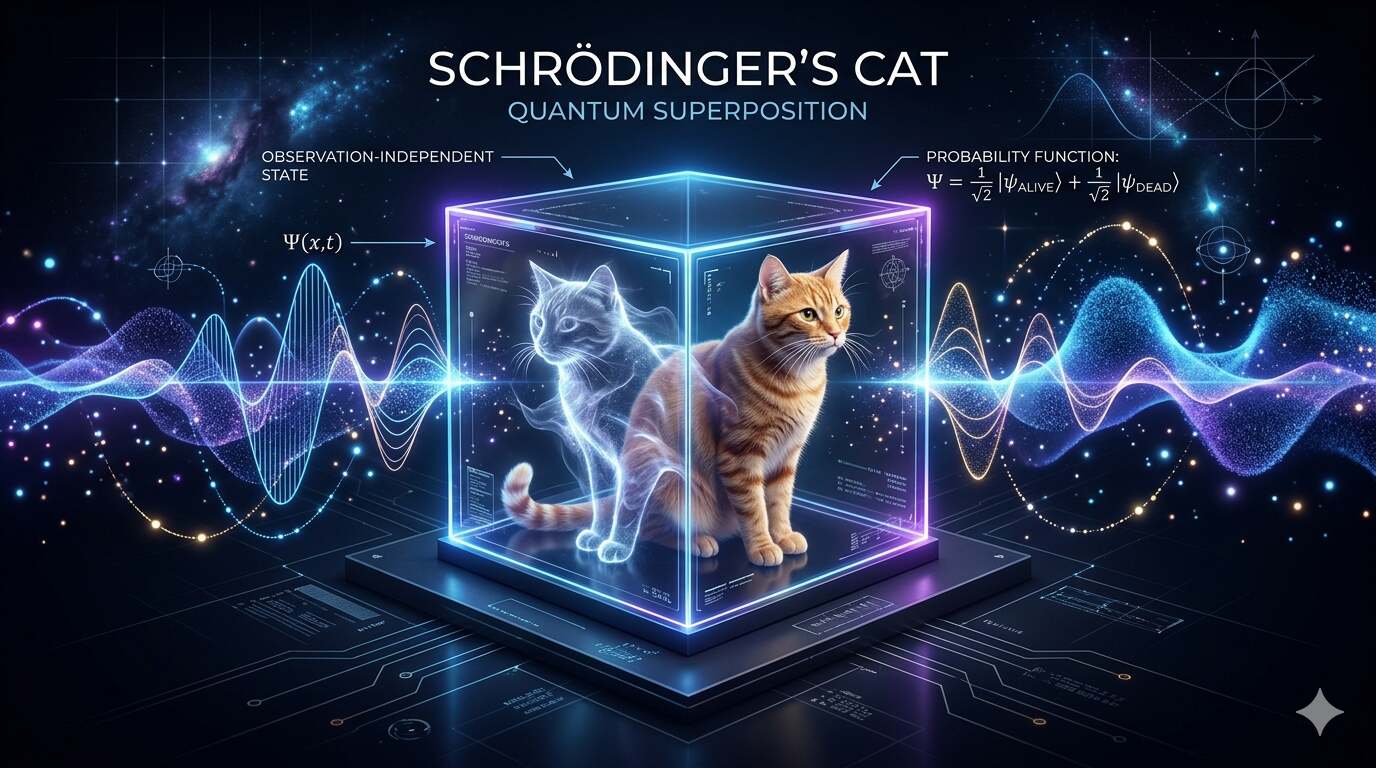
This idea became widely known through a famous thought experiment involving a cat. According to the story, the cat could be both alive and dead until someone checks on it.
How can that be possible? Is the cat truly in two states at once, or is the experiment trying to teach us something deeper about physics?
Let us look at what quantum superposition means and why the example of Schrödinger’s cat still matters today.
What Is Quantum Superposition?
Quantum superposition describes a situation where a quantum system exists in multiple possible states at the same time.
Instead of choosing a single state immediately, a particle holds several possibilities together until a measurement occurs.
For example, an electron can exist in different positions or energy levels simultaneously. When scientists observe it, the system settles into one specific outcome.
This idea challenges everyday intuition. In the normal world, objects appear to have one clear state at a time.
Yet at the quantum scale, nature behaves differently.
The Thought Experiment of Schrödinger’s Cat
In 1935, physicist Erwin Schrödinger introduced a thought experiment to show how unusual quantum theory can appear.
The setup is simple but striking:
- A cat is placed inside a sealed box.
- Inside the box is a tiny radioactive particle.
- If the particle decays, a detector triggers poison that kills the cat.
- If no decay happens, the cat remains alive.
Quantum theory says the particle can exist in a superposition of decayed and not decayed states.
Because the cat’s fate depends on that particle, the entire system becomes linked. In theory, until someone opens the box, the cat is both alive and dead.
Schrödinger created this scenario to highlight how strange quantum theory seems when applied to everyday objects.
Why the Cat Example Was Proposed
The goal of this experiment was not to claim that cats truly exist in two conditions at once.
Instead, Schrödinger wanted to question how quantum ideas apply to large objects.
Quantum superposition works well for particles such as electrons or photons. But when the same logic extends to larger systems, the result appears absurd.
The thought experiment raised an important question:
Where does the quantum world stop and the classical world begin?
Scientists still study this boundary today.
How Observation Changes the System
A key point in quantum mechanics is the role of measurement.
Before measurement, the system is described as a collection of probabilities. After measurement, one outcome appears.
In simplified terms, the system moves from several possible states into one definite state.
Physicists describe this idea with the wave function.
|ψ⟩ (Psi) = a|0> + b|1>
Meaning of Each Part
1. |ψ⟩ (Psi)
This symbol represents the state of the quantum system.
Think of it as a description of everything we can know about the particle before measuring it.
2. |0⟩ and |1⟩
These are the possible states the system can be in.
For example in a quantum computer:
- |0⟩ → state 0
- |1⟩ → state 1
Unlike a classical bit, a quantum bit (qubit) can involve both states together.
3. a and b
The letters a and b are numbers that describe the probability of each state.
- a² → probability of measuring state 0
- b² → probability of measuring state 1
And they follow an important rule:∣a∣2+∣b∣2=1
This ensures the total probability is 100%.
Simple Analogy
Imagine spinning a coin.
- Heads = state 0
- Tails = state 1
While the coin is spinning, you cannot say it is only heads or only tails.
It has characteristics of both possibilities until it lands.
Quantum superposition works somewhat like this — except the system truly contains multiple states until measurement.
Real Examples of Quantum Superposition
While Schrödinger’s cat is a thought experiment, superposition happens in real laboratories.
Scientists observe it in systems such as:
Electrons in Atoms
Electrons do not stay in one exact position. Instead, they exist in probability patterns until measured.
Quantum Computing
Quantum bits, or qubits, can represent multiple values at once thanks to superposition. This property allows certain calculations to run much faster than traditional computers.
Interference Experiments
In experiments like the double-slit setup, particles behave like waves and create interference patterns. This behavior shows that they pass through multiple paths simultaneously.
These examples confirm that superposition is not just theory. It is part of how nature works.
Why Quantum Superposition Matters
Quantum superposition forms the foundation of many modern technologies and research areas.
It helps scientists develop:
- Quantum computers
- Ultra-precise sensors
- Advanced communication systems
- New approaches to cryptography
Researchers continue studying how long superposition can survive and how it disappears in larger systems.
Understanding this process could lead to major scientific progress.
What Schrödinger’s Cat Really Teaches Us
The cat story is not about animals existing in strange conditions. It is a tool that helps people think about the limits of quantum theory.
It highlights three key ideas:
- Quantum systems can exist in multiple states simultaneously.
- Observation plays a role in determining outcomes.
- Applying quantum rules to everyday objects raises deep questions about reality.
These questions still shape research in modern physics.
Conclusion
Quantum superposition shows that particles can exist in several possible states at once until measurement occurs. This idea challenges our everyday understanding of reality.
The famous cat experiment created by Erwin Schrödinger helps illustrate how strange quantum mechanics can appear when applied to large objects. Rather than proving that cats exist in two states, the example pushes scientists to think carefully about the boundary between the quantum and classical worlds.
As research continues, quantum superposition remains one of the most important concepts in physics and a key part of future technologies.