Unraveling the Invisible Threads: How Quantum Entanglement is Changing Our World
Remember our discussion about quantum computing? We briefly touched upon entanglement, that “spooky” connection between particles. While it sounds like something straight out of a science fiction novel, quantum entanglement is a very real phenomenon, and it’s not just a curiosity for physicists. It’s a powerful tool that is already beginning to reshape our world, from secure communication to next-generation computing.
But what exactly is this invisible thread that links particles, and how can something so bizarre have practical uses? Let’s unravel the mystery from the very beginning.
What is Entanglement? The “Magic Coin” Analogy
Imagine you have two coins. You place one in an envelope and give it to a friend, who then travels to the other side of the world. You keep the other coin in your own envelope. Now, here’s the magic part: these aren’t ordinary coins. Before you look, each coin is in a fuzzy state—it’s neither heads nor tails, but a combination of both.
Now, you open your envelope and see your coin is “heads.” Instantly, without anyone communicating or even looking at your friend’s coin, you know that your friend’s coin is “tails.” And if your coin was “tails,” your friend’s would be “heads.” This happens instantaneously, regardless of the distance between you.
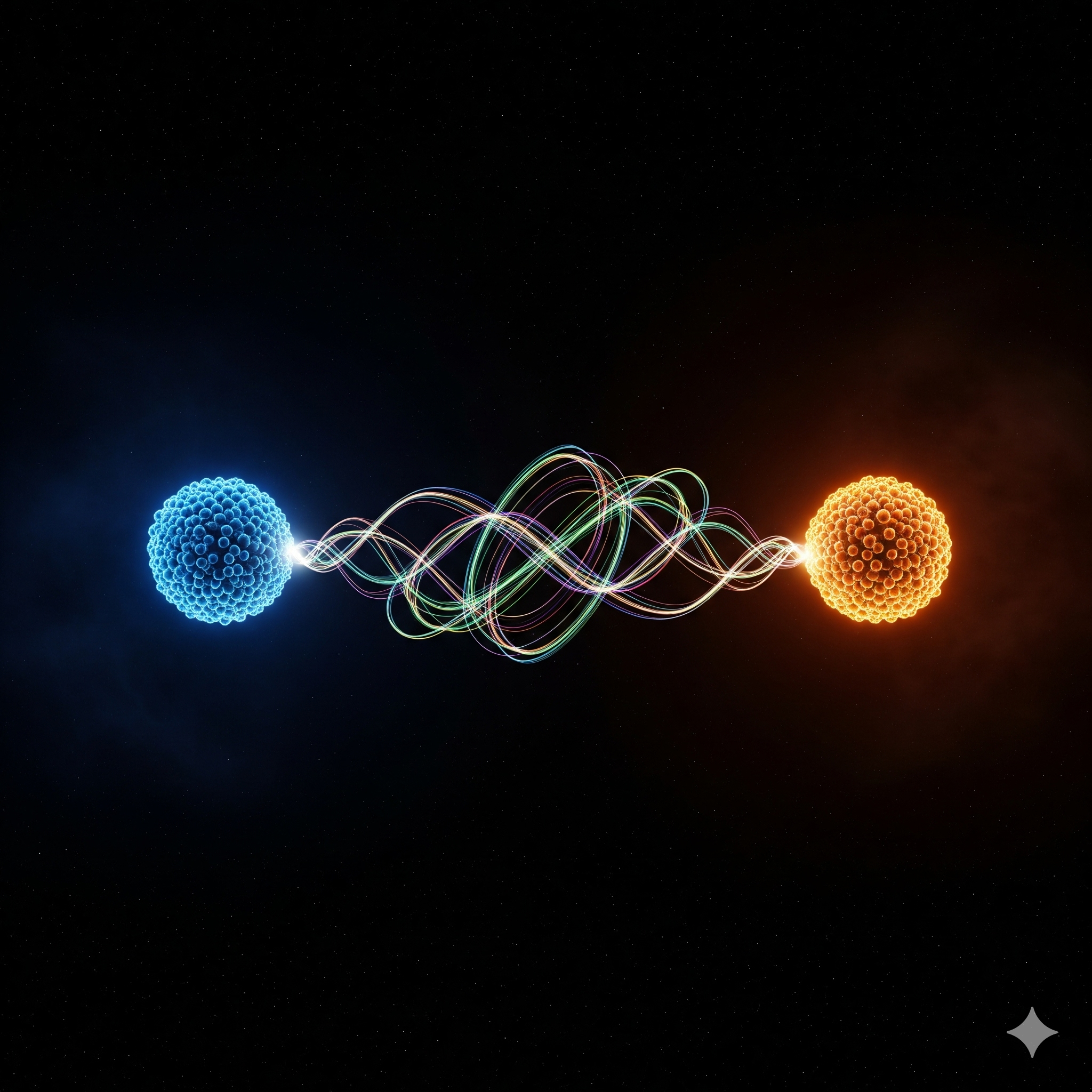
This is a simplified way to think about quantum entanglement. Two particles (like our coins) become linked in such a way that their fates are intertwined. They exist in a shared, uncertain state until one is observed. The moment you observe one particle and determine its state, the state of its entangled partner is simultaneously determined, no matter how far apart they are. There’s no signal being sent; it’s an intrinsic connection.
This “spooky action at a distance,” as Albert Einstein famously called it, means that entangled particles essentially act as a single system, even when separated.
Why Does Entanglement Happen?
At the quantum level, particles don’t have definite properties (like “spin up” or “spin down”) until they are measured. Before measurement, they exist in a superposition of all possible states. When two particles interact in a specific way (like being created together or passing through a particular crystal), their superpositions can become linked. This link is entanglement.
When you measure one entangled particle, its superposition “collapses” into a definite state. Because of the entanglement, the superposition of its partner also collapses, instantly taking on the corresponding definite state, even if it’s light-years away. This is one of the most counterintuitive yet well-verified phenomena in all of physics!
Real-World Applications of Quantum Entanglement
So, beyond fascinating physicists, how is this bizarre connection actually useful? Here are some incredible ways quantum entanglement is poised to change our world:
- Quantum Cryptography (Unbreakable Communication): Imagine sending a secret message that is absolutely, fundamentally uncrackable. This is possible with Quantum Key Distribution (QKD), which uses entangled particles to create an encryption key. If an eavesdropper tries to intercept the entangled particles, the act of observation (measurement) will disturb their delicate entangled state. This disturbance is immediately detectable by the legitimate users, alerting them to the security breach. This means you’ll always know if someone is listening in, making the communication inherently secure. Governments and banks are already exploring this technology for ultra-secure communication.
- Quantum Computing (Enhanced Processing Power): As we discussed, quantum computing harnesses both superposition and entanglement to achieve its incredible processing power. While superposition allows qubits to exist in multiple states at once, entanglement allows these qubits to be linked. This linking enables a quantum computer to perform many calculations simultaneously and efficiently, exploring vast computational spaces far beyond classical computers. Entanglement is the backbone that allows multiple qubits to work together in a coordinated, powerful way to solve complex problems like drug discovery or materials design.
- Quantum Internet (The Future of Networking): Just as the classical internet connects classical computers, a quantum internet aims to connect quantum computers using entangled particles. Instead of sending information as bits, a quantum internet would transmit qubits, maintaining their delicate quantum states over long distances through “quantum repeaters.” This would enable distributed quantum computing, where multiple quantum machines could work together, and facilitate truly global, unhackable communication networks that rely on QKD across continents. We are still in the early stages, but prototypes are already being built.
- Enhanced Sensing and Metrology (Ultra-Precise Measurements): Quantum entanglement can be used to create extremely sensitive sensors that are far more precise than classical ones. By entangling particles, their collective properties can be measured with much greater accuracy. This could lead to revolutionary improvements in fields like medical imaging (e.g., more detailed MRIs), highly sensitive gravitational wave detectors, and more accurate atomic clocks for navigation systems like GPS, allowing for pinpoint precision never before possible.
The Entangled Future
From a phenomenon that baffled Einstein to a cornerstone of tomorrow’s technology, quantum entanglement is a testament to the strange and wonderful rules governing our universe. It’s a reminder that sometimes the most abstract scientific discoveries hold the key to the most profound technological advancements. As we continue to explore and harness these invisible threads, the “quantum revolution” will undoubtedly continue to weave its way into every aspect of our lives.
What application of quantum entanglement do you find most mind-blowing? Let us know in the comments below!